



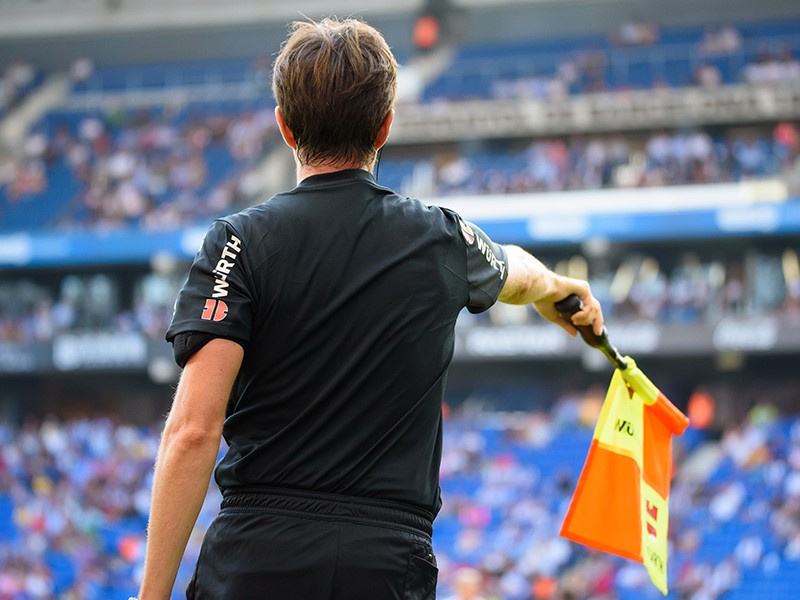
The delayed offside flag could become far less common at the 2026 World Cup after FIFA approved a new version of its semi-automated offside system for use by video assistant referees. The governing body believes the upgrade will speed up decision-making and allow assistant referees to signal offences earlier instead of waiting for attacking moves to conclude.
The delayed offside flag could become far less common at the 2026 World Cup after FIFA approved a new version of its semi-automated offside system for use by video assistant referees. The governing body believes the upgrade will speed up decision-making and allow assistant referees to signal offences earlier instead of waiting for attacking moves to conclude.
Under the revised system, assistants will receive an immediate audio notification whenever a player is detected to be more than 10 centimetres beyond the last defender. Earlier versions of the technology, tested during the Club World Cup and Intercontinental Cup, only generated alerts when players were at least 50 centimetres offside.
Although the technology provides automatic notifications, the final decision on when to stop play will remain with the match official. Assistants can choose not to raise the flag if they suspect a technical issue, though FIFA says multiple safeguards have been included to minimise the risk of malfunctions.
The upgraded system will not eliminate every offside controversy. Fifa acknowledges that the technology cannot reliably determine the tightest offside situations and may face difficulties when players are lying on the pitch or when several players are positioned very close together.
Its use will also be restricted to positional offside incidents. Situations requiring interpretation, such as whether a player has obstructed an opponent's vision or movement without touching the ball, will still require officials to make a subjective judgement.
FIFA hopes the changes will reduce frustration among players and supporters while also limiting unnecessary periods of play that are eventually halted for offside offences.
The issue gained additional attention in May 2025 when Nottingham Forest forward Taiwo Awoniyi was placed in an induced coma after crashing into a goalpost during a passage of play in which an offside flag had been delayed.
Alongside the offside system, FIFA confirmed that every player participating in the tournament will have an AI-supported three-dimensional avatar created to assist with decision-making.
The process will involve digitally scanning all 1,248 footballers included in the 26-player squads of the 48 competing nations. Each scan will be carried out during pre-tournament media sessions and is expected to take approximately one second per player.
According to FIFA, these digital recreations will allow officials and viewers to see more detailed and accurate offside visualisations than those currently available.
FIFA has also authorised technology capable of determining whether the ball left the field before a goal was scored. The system can generate a three-dimensional animation showing the exact position of the ball, similar to the visualisations already used in goal-line technology.
The sensor embedded in the ball will also identify the last player to make contact with it. This information is expected to assist VAR officials when reviewing decisions such as whether a corner kick or goal kick should have been awarded.
Another enhancement involves the expansion of real-time 3D recreation technology for line-of-sight assessments in offside situations. Two virtual camera feeds will recreate the view from each goalkeeper's position, giving both VAR officials and television audiences a clearer understanding of what the goalkeeper could see.
The addition follows several incidents during the season in which debate centred on whether an offside player had obstructed a goalkeeper's vision. FIFA believes the new visual tool will help officials reach those decisions more efficiently and with greater clarity.


