


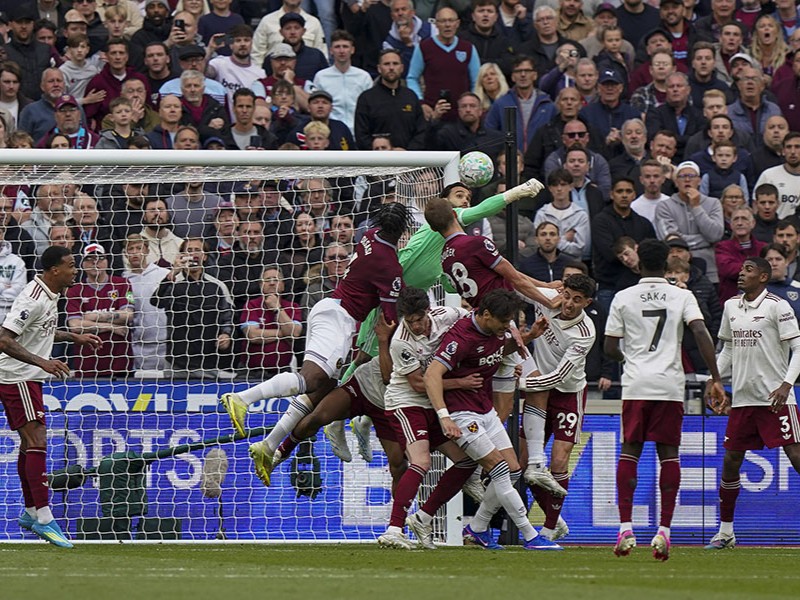
This Premier League campaign has been shaped not only by goals from dead-ball situations but also by the relentless physical contests that now define them. Wrestling, shirt-pulling, blocking, and obstruction inside penalty areas have become so common that corners can resemble outright disorder before the ball is even struck.
This Premier League campaign has been shaped not only by goals from dead-ball situations but also by the relentless physical contests that now define them. Wrestling, shirt-pulling, blocking, and obstruction inside penalty areas have become so common that corners can resemble outright disorder before the ball is even struck.
The issue was highlighted in February when Manchester United and Everton players crowded the six-yard area in scenes described as near-chaotic, with bodies hitting the turf before play had officially restarted. Everton manager David Moyes voiced the growing frustration, suggesting referees were increasingly hesitant to intervene despite the obvious disorder.
The trend is far from exclusive to England. At a recent UEFA refereeing event, Roberto Rosetti focused heavily on examples of goalkeepers being targeted during set pieces, underlining that pressure on keepers has become a broader concern across European football.
Arsenal’s effectiveness from corners has placed them at the centre of this tactical evolution. Their strategy of surrounding goalkeepers, congesting the six-yard box, and engineering space has made them the league’s benchmark, with 21 of their 68 league goals coming from set pieces. Their mastery has influenced rivals throughout the division, but it has also intensified scrutiny on where physicality ends and fouling begins.
The defining controversy arrived when West Ham thought they had scored from a corner against Arsenal, only for VAR to overturn the goal after an extended review of multiple clashes inside the area. Jarrod Bowen’s delivery into a packed box led to a scramble before Callum Wilson forced the ball over the line, but the sequence contained numerous possible infringements.
The earliest incident involved Tomas Soucek and Kai Havertz at the near post, where Soucek climbed over the Arsenal player, leaving Havertz on the ground. Because the pair were not in the likely landing zone of the cross and Soucek was facing the ball, this was not judged severe enough to warrant intervention.
Martin Odegaard and Jean-Clair Todibo were also locked in mutual holding, a situation typically viewed as shared responsibility rather than a one-sided offence. Leandro Trossard’s tussle with Pablo was more significant, particularly when Trossard grabbed him around the waist, but Pablo still reached the flight path and was not clearly prevented from competing.
The decisive foul came when Pablo impeded David Raya directly. His positioning and arm placement restricted the Arsenal goalkeeper’s movement, pinning one arm while holding the other. This limitation on Raya’s ability to challenge for the ball became the key factor in VAR’s decision. Declan Rice’s hold on Konstantinos Mavropanos also raised questions, but because Pablo’s infringement had the clearest impact on the goalkeeper’s attempt to play the cross, that offence took priority.
Despite widespread complaints about grappling from corners, West Ham’s disallowed effort remains the only Premier League goal this season overturned by VAR specifically for this type of offence. Other set-piece controversies have produced different outcomes because officials have judged contact levels differently.
When Arsenal scored against Manchester United, William Saliba applied pressure to goalkeeper Altay Bayindir, but the contact was not considered sufficient to stop him from challenging. Officials ruled there was no unlawful push or hold despite congestion around the keeper.
A similar conclusion was reached when Arsenal faced Aston Villa. Gabriel’s aerial duel with Emiliano Martínez included some contact, yet not enough to prove meaningful interference. Without clear restriction, the goal stood.
Manchester City’s clash with Bournemouth offered another example, when David Brooks initially held Gianluigi Donnarumma but released him before the goalkeeper attempted to play the ball. Timing proved crucial, as the absence of sustained restriction meant the officials allowed the goal.
The roots of modern set-piece strategy can be traced through several Premier League managers. Tony Pulis and Sam Allardyce were among the first to heavily emphasise dead-ball situations, using calculated positioning and data-driven routines to exploit high-probability zones.
Sean Dyche’s Burnley later advanced this by targeting deliveries just yards from goal while disrupting goalkeepers’ movement, creating a more aggressive version of the approach. Though Burnley lacked Arsenal’s technical precision, they helped shape the tactical framework.
Mikel Arteta’s Arsenal, supported by set-piece coach Nicolas Jover, refined these ideas further. High-quality deliveries from Declan Rice and Bukayo Saka, combined with Gabriel’s aerial strength, turned corners into one of the division’s most dangerous attacking weapons.
Their success has triggered imitation across the league, with clubs such as Manchester United, Chelsea, and Tottenham increasingly adopting crowded six-yard routines and inswinging deliveries.
A major challenge for officials is that much of the wrestling begins before the ball is technically in play, limiting referees largely to warnings or retakes. Because this rarely prevents repeated offences, criticism has grown louder.
At season’s end, PGMOL gathers feedback from managers, players, broadcasters, and supporters, and this summer grappling and even hair-pulling may become central discussion points. One possible response could involve stricter pre-corner bookings.
Former assistant referee Darren Cann proposed a more radical solution: banning attacking players from entering the six-yard box until the kick is taken. Such a rule would automatically create separation and reduce direct pressure on goalkeepers.
Another idea would make play active as soon as the ball is placed, allowing fouls before delivery to result in penalties or free kicks. Whether through law changes or tactical restraint, football’s authorities may soon need to decide whether corner kick chaos has gone too far.


