


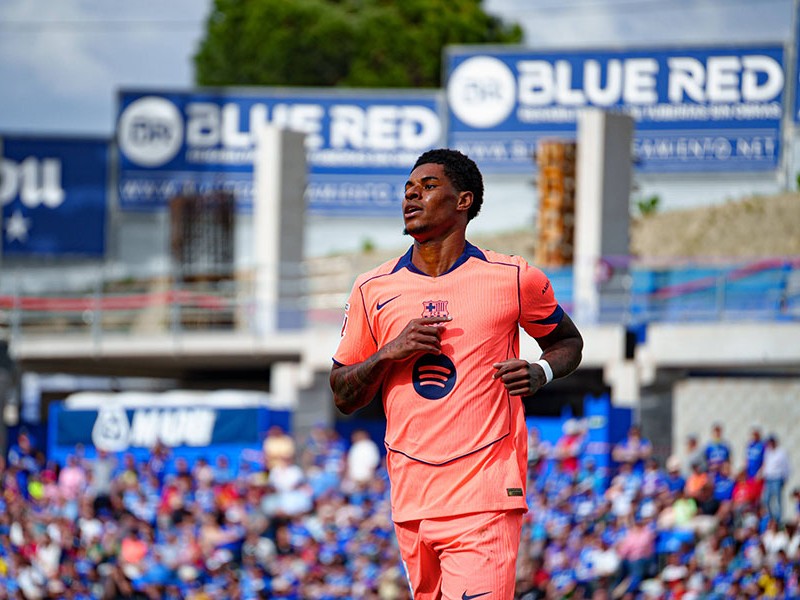
There is a side to every transfer story that rarely appears in public. Beyond speculation, headlines and constant analysis, there are private moments when players and their families absorb the latest claims about their future. For Marcus Rashford, that reality has been especially familiar in recent months as reports continue to question Barcelona’s long-term plans for him.
There is a side to every transfer story that rarely appears in public. Beyond speculation, headlines and constant analysis, there are private moments when players and their families absorb the latest claims about their future. For Marcus Rashford, that reality has been especially familiar in recent months as reports continue to question Barcelona’s long-term plans for him.
When Rashford chose to leave England for Barcelona last summer, it came after a turbulent period, despite a successful half-season at Aston Villa. His connection with Manchester United appeared beyond repair, and the environment around him had become overwhelming. Moving to Spain represented both risk and opportunity, especially given the pressure attached to joining one of football’s most demanding institutions.
His arrival was far from straightforward. Rashford entered a squad already deeply shaped by Hansi Flick’s tactical ideas, had no proper pre-season, and even made his debut against Mallorca before fully training with his new team-mates. For some, such circumstances would have made the campaign feel transitional. Rashford approached it differently, treating it as an opportunity to immediately prove himself.
From the beginning, he adapted to new surroundings, language, and expectations while still delivering in attack. Rather than simply settling in, he worked to become an effective contributor in one of Europe’s most competitive dressing rooms.
Barcelona possess remarkable depth in forward areas, yet Rashford’s output has placed him alongside some of the biggest names in Spain. His goal against Barcelona’s latest opponents on Saturday was his 12th of the season, another contribution in a campaign that has steadily strengthened his reputation.
Measured by direct goal involvement per minute — including goals, assists, and penalties won — Rashford has produced at a rate of one every 92 minutes. That places him level with or ahead of several elite attackers across Barcelona, Real Madrid, and Atletico Madrid. Raphinha and Kylian Mbappé match one every 96 minutes, and Lamine Yamal every 102, while Vinícius Júnior trails further behind.
Those figures underline how effective Rashford has been in the exact areas Barcelona targeted: direct running, dribbling, finishing, and attacking purpose. Only Lamine Yamal surpasses him in dribbling, while only Raphinha exceeds him in attacking movement, placing Rashford statistically in exceptional company.
For an English player experiencing a debut La Liga season, those returns are particularly significant. They suggest that despite external noise, his football has largely met the challenge.
Barcelona’s recent history shows that many major forwards have needed time before thriving in their first season. Compared with names such as Thierry Henry, Zlatan Ibrahimović, Neymar, Ousmane Dembélé, and Robert Lewandowski, Rashford’s impact has been stronger than most, with Luis Suárez standing as the main exception.
Flick’s influence has been important. Rashford has improved under his guidance, and while Barcelona’s squad contains seven players competing for three attacking places, only Lamine Yamal has played significantly more minutes. Rashford has had to navigate rotation rather than enjoy automatic selection, constantly competing with world-class alternatives.
That challenge has required adjustment. Previous frustrations over not starting regularly have given way to greater acceptance. At Barcelona, Rashford has embraced the demands of waiting for opportunities without complaint, understanding the extraordinary level of those around him.
Some criticism has suggested he can drift through matches or that his personality may not naturally suit the culture. Yet those close to him view such claims as exaggerated. Instead, they point to major performances, particularly the Champions League home game against Atletico, where, despite defeat, he was considered Barcelona’s standout player, as evidence of his true level.
Even with strong performances, stories continue linking Barcelona with other attacking reinforcements while questioning whether Rashford will stay. Suggestions that the club could spend his reported 30m euro valuation elsewhere have inevitably caused frustration among those around him.
Inside his camp, however, there is no sense of alarm. They see such speculation as a normal stage in negotiations, particularly late in the season when public discussion often differs from private reality. Rashford’s focus remains on patience, with those close to him insisting the situation will become clearer in time.
The core issue appears financial rather than sporting. Barcelona’s restrictions under financial fair play rules are shaping their planning, and decisions are influenced heavily by what the club can realistically afford rather than dissatisfaction with Rashford himself.
Flick’s support is seen as genuine, and that matters. While external discussion may suggest uncertainty, internally the manager’s opinion remains an important factor.
Rashford’s preference is clear: he wants to stay. Financially, remaining in Barcelona would mean earning less than a return to Manchester, but his desire is rooted in happiness rather than salary.
Barcelona’s wider transfer plans complicate matters. With Lewandowski leaving, the club is pursuing two forwards. Julian Alvarez is reportedly their primary target, though his price may be beyond reach. Their second desired option is a different attacking type, one more closely aligned stylistically with Lamine Yamal and Raphinha in pressing, aggression, and tight-space link-up play.
That profile may not naturally describe Rashford, but his future is still unresolved. Negotiations continue, and those closest to him believe much of the surrounding conversation is strategic positioning rather than final judgment.
For now, Rashford is in a better place emotionally and professionally than he has been for some time. Playing with renewed freedom, he appears shaped by past experiences, more aware that football’s external world can shift quickly even when performance levels remain high.


