


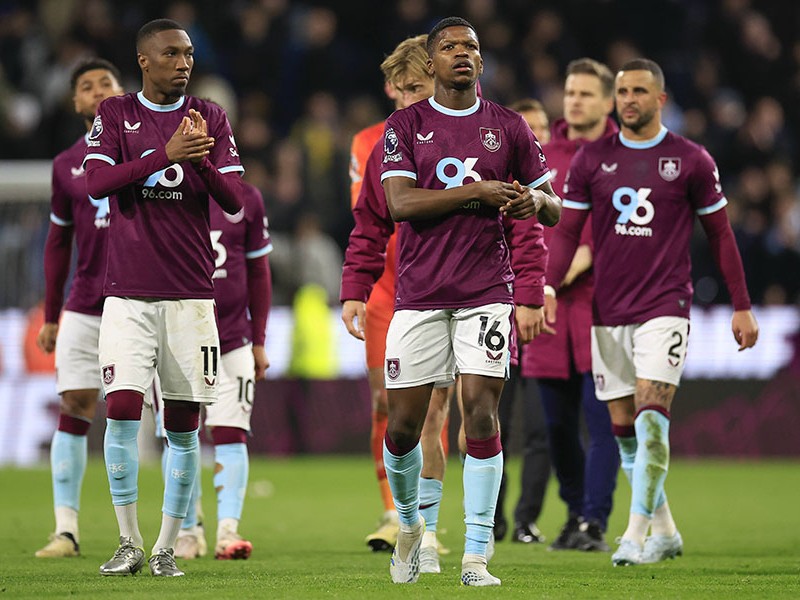
Burnley’s latest relegation from the Premier League, confirmed by a 1-0 defeat to Manchester City, has reinforced their status as one of English football’s modern “yo-yo” sides. The drop means the club will spend a fifth consecutive season alternating between the top flight and the Championship, a pattern only previously matched by Fulham between 2017-18 and 2021-22.
Burnley’s latest relegation from the Premier League, confirmed by a 1-0 defeat to Manchester City, has reinforced their status as one of English football’s modern “yo-yo” sides. The drop means the club will spend a fifth consecutive season alternating between the top flight and the Championship, a pattern only previously matched by Fulham between 2017-18 and 2021-22.
Former winger Glen Little believes the immediate outlook is predictable, even if the long-term picture is not. He expects Burnley to challenge strongly for promotion again next season but admits there is lingering doubt about their ability to survive once they return to the Premier League. Manager Scott Parker echoed that sentiment, acknowledging the need for reflection after another unsuccessful campaign at the highest level.
Despite the disappointment, the club’s recent history suggests resilience in the second tier. Each relegation in recent years has been followed by a swift return, creating a repetitive cycle that has become both a strength and a limitation. While promotion remains achievable, establishing stability in the Premier League continues to elude them.
The bigger issue is whether Burnley can break this pattern or if they are effectively stuck within it. For now, the immediate priority appears to be another push for promotion, even if that risks repeating the same outcome once more.
The contrast with the era under Sean Dyche is striking. During his time in charge, Burnley spent six of eight full seasons in the Premier League and even qualified for European competition, all while operating with limited resources. That period brought consistency and a clear identity built on cohesion and resilience.
Since Dyche’s departure in April 2022, however, the club has experienced constant change. Relegation followed shortly after his exit, before Vincent Kompany guided Burnley to a dominant Championship title with 101 points. Yet that success did not translate to the Premier League, where they struggled and were relegated again after collecting just 24 points.
Kompany’s approach marked a significant shift in playing style and recruitment, with an influx of young and international players replacing the traditional profile associated with the club. While it proved effective in the Championship, it failed to deliver results at the higher level, and his subsequent move to Bayern Munich left another transition for Burnley to manage.
Scott Parker then oversaw another promotion-winning campaign, this time built on defensive solidity, conceding only 16 goals. Even so, the latest relegation suggests that altering tactics and recruitment strategies has not solved the fundamental problem of competing in the Premier League.
Looking forward, uncertainty surrounds both the squad and the managerial position. Parker has an impressive record of securing promotion from the Championship, having done so with Fulham, Bournemouth, and now Burnley, but he has yet to keep a team in the Premier League. Whether he remains in charge will be a key decision for the club.
There are also questions about player retention and finances. Burnley’s recent model has involved significant turnover, particularly following relegation, which has disrupted continuity. Keeping a core group together could improve their chances of another promotion, but it also raises the challenge of building a squad capable of surviving in the top division.
Parachute payments provide some financial cushioning, and Burnley have benefited from them repeatedly due to their quick returns to the Premier League. This cycle ensures a steady flow of revenue, but it may also contribute to the pattern of short-term rebuilding rather than long-term stability.
For now, the expectation is another strong Championship campaign. The more difficult task is ensuring that, if promotion is achieved again, it leads to something more sustainable than a one-season stay.
This season began with promise, as Burnley collected 10 points from their first nine matches. However, their form collapsed dramatically, with just one league win after the end of October. A 3-2 defeat to West Ham, after leading 1-0, is seen as a turning point from which the team never recovered.
Confidence gradually eroded, and a series of narrow setbacks and contentious VAR decisions compounded their struggles. As results worsened, Parker experimented with multiple formations and attacking setups, but none provided a consistent solution.
Supporters have grown increasingly frustrated, with criticism focusing on a perceived lack of identity and a departure from the traditional characteristics associated with the club. The sense of direction that once defined Burnley has been replaced by uncertainty and inconsistency.
Although relegation is a setback, it is not the worst possible outcome. Other clubs have suffered consecutive drops into lower divisions, whereas Burnley have at least maintained the ability to bounce back immediately. Still, without meaningful change, the risk is that the cycle simply continues.


